Blog · Nutrition
Do potatoes have gluten? What the evidence says
Potatoes contain no gluten. Gluten comes only from wheat, rye, barley and oats, while potato protein is mostly patatin and protease inhibitors. Gluten in fries and wedges comes from wheat coatings, seasonings or shared fryers, and restaurant tests show how often that happens.
Potatopedia Editorial··6 min read·1,194 words
In this story · 11
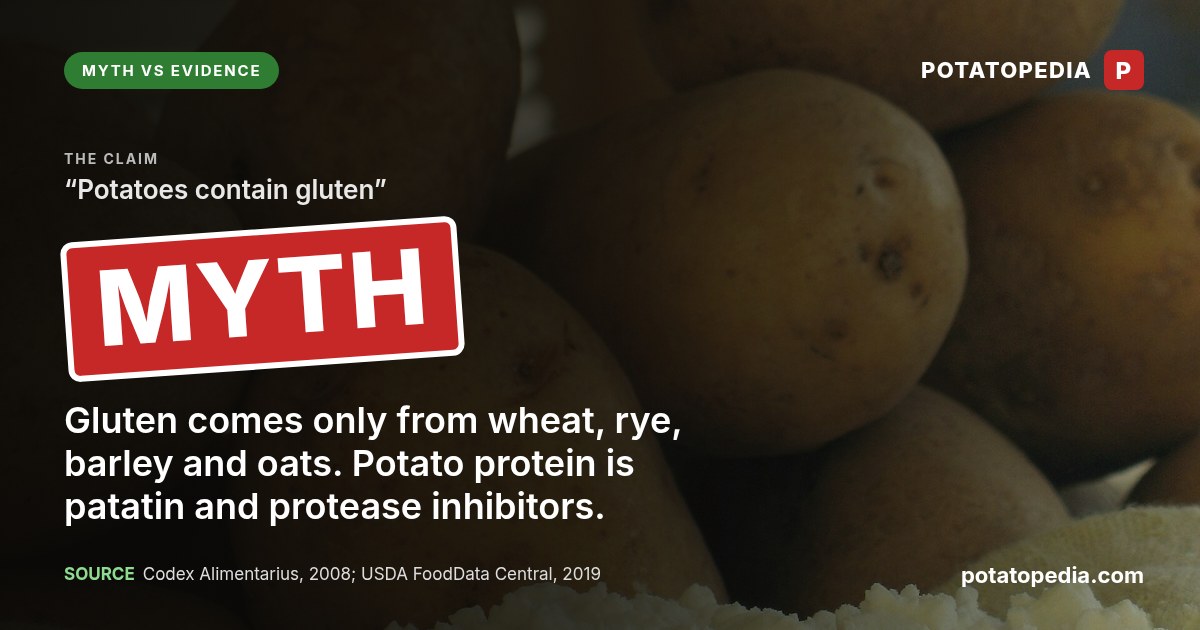
No. Potatoes contain no gluten. Gluten is a protein fraction found only in wheat, rye, barley, oats and their crossbreds, and the potato is an unrelated tuber whose main proteins are patatin and protease inhibitors. Gluten reaches potato foods only through added wheat flour, coatings or seasonings, or through cross-contact in kitchens and fryers.
Where does the idea that potatoes contain gluten come from?
The claim usually starts with processed food. Potatoes are starchy, they appear next to bread and pasta in discussions about carbohydrates, and many potato products sold in shops and restaurants do contain wheat. A plate of seasoned fries or battered wedges can carry gluten, so the potato itself gets the blame.
Testing the claim means separating two questions. Does the potato tuber contain gluten? And can foods made from potatoes contain gluten? The two answers differ.
What is gluten, and which crops contain it?
The international food standard for people intolerant to gluten, Codex Alimentarius Standard 118-1979, defines gluten as a protein fraction from wheat, rye, barley, oats or their crossbred varieties and derivatives, to which some people are intolerant and which does not dissolve in water or in 0.5M salt solution. Wheat here means all Triticum species, including durum wheat, spelt and kamut.
The part of gluten that matters most for coeliac disease is the prolamin fraction, the share that can be extracted with 40–70% ethanol. The standard names one prolamin per grain: gliadin in wheat, secalin in rye, hordein in barley and avenin in oats. It takes the prolamin content of gluten as 50%.
Oats carry a footnote: most but not all people intolerant to gluten tolerate them, so each country decides whether uncontaminated oats may be used in gluten-free foods. All four crops are cereal grasses. The potato, Solanum tuberosum, belongs to the nightshade family with tomato and aubergine, and is not on the list.
What proteins does a potato contain?
Potatoes are low in protein. A raw potato with flesh and skin has 2.05 g of protein per 100 g, with 17.5 g of carbohydrate, 0.09 g of fat and 79.2 g of water, in the USDA reference data released in 2019. Red and white potatoes in the same database have 1.89 g and 1.68 g of protein per 100 g.
That small protein share is made of different molecules from gluten. A 2017 review in the journal Molecules describes the soluble proteins of potato juice as patatins, at 30–40%, and protease inhibitors, at 40–50%, with other proteins making up the rest. The same paper puts patatin at about 40% of all soluble protein in potato tubers. Neither group is a prolamin of wheat, rye, barley or oats, so neither meets the definition of gluten.
How is "gluten-free" defined on food labels?
The Codex standard sets a limit rather than demanding zero. A food can be labelled gluten-free if it is made only from ingredients that do not contain the listed grains and its gluten level does not exceed 20 mg/kg, measured on the food as sold. Foods made from those grains and specially processed to bring gluten down to more than 20 and up to 100 mg/kg must not be called gluten-free.
A limit of 20 mg/kg is the same as 20 parts per million (ppm), the cut-off the United States uses for packaged foods labelled gluten-free. The standard also covers foods that are gluten-free by nature: a food which by its nature suits a gluten-free diet must not be labelled "special dietary". Plain potatoes belong in this group.
How does gluten end up in potato products?
Mostly through recipes. Some frozen fries are coated with a batter to make them crisper or to hold seasoning. The USDA's branded-food records, which reproduce the ingredient lists on US packs, show enriched or bleached wheat flour among the ingredients of seasoned, spiral, shoestring and curly fries sold under several retailer brands. Such products contain gluten from the wheat, not from the potato.
The other routes are seasonings and sauces with wheat-based ingredients, and cross-contact in kitchens: shared fryers, shared surfaces and shared utensils. The Codex standard requires gluten-free products to be prepared under good manufacturing practice to avoid contamination with gluten.
What do tests on restaurant fries show?
Three studies have measured gluten in fries, each with a different design. A 2021 pilot study in Frontiers in Nutrition bought 20 orders of plain salted fries from 10 restaurants in California and Ohio that cooked them in fryers shared with wheat. With a sandwich R5 ELISA test, 9 of the 20 orders had measurable gluten and 5 orders (25%) were above 20 ppm. The authors noted that the test may under-read heated gluten and called for a much larger study.
A 2019 study in the American Journal of Gastroenterology analysed 5,624 tests by 804 users of a portable gluten sensor in the United States between August 2016 and January 2018. Of restaurant foods described as gluten-free, 32.0% tested positive, including 30.3% of French fries, 53.2% of pizza and 50.8% of pasta. Users chose what to test, and the device can react below 20 ppm, so the authors warn that these rates may overstate contamination.
The largest direct measurement came in 2026. A cross-sectional study in Nutrients tested 98 restaurant samples from several US states, 55 French fries and 43 tortilla chips, by ELISA. Six samples, all fries, exceeded 20 ppm, or 10.9% of the fries, and 84 of the 98 samples (85.7%) were below 5 ppm. Foods from venues that reported changing fryer oil daily all measured below 20 ppm, while weekly oil changes went with higher and more variable levels.
So, do potatoes contain gluten? The verdict
Myth. The potato tuber contains no gluten: its proteins are patatins and protease inhibitors, not the prolamins that define gluten in wheat, rye, barley and oats. A plain potato, boiled, baked or mashed without wheat-based ingredients, fits the Codex description of a food that is gluten-free by nature.
The claim has a narrow basis in processed and restaurant food. Coated or seasoned fries can list wheat flour as an ingredient, and fries cooked in shared fryers tested above 20 ppm in 25% of orders in one small study and in 10.9% of samples in a larger one. In each case the gluten comes from wheat added to or carried into the food, so the ingredient list and the kitchen's practice decide whether a potato product is gluten-free.
Are French fries gluten-free?
Fries made only from potatoes, oil and salt contain no gluten ingredients. Some frozen fries are coated with wheat flour, which the ingredient list shows. In restaurants, fries cooked in fryers shared with breaded foods can pick up gluten: a 2026 study found 10.9% of 55 fry samples above 20 ppm, with lower levels where fryer oil was changed daily.
Is potato starch gluten-free?
Potato starch is extracted from the potato tuber, which contains no gluten, so the ingredient itself has none. A product made with potato starch can still contain gluten if it also includes wheat, rye, barley or oat ingredients, or if it is contaminated during processing. Under the Codex standard, a food labelled gluten-free must not exceed 20 mg/kg of gluten as sold.
How common is coeliac disease?
A 2018 systematic review and meta-analysis of 96 articles, published in Clinical Gastroenterology and Hepatology, put the global prevalence of coeliac disease at 1.4% on blood tests, from 275,818 people, and 0.7% when confirmed by biopsy, from 138,792 people. By region, prevalence ranged from 0.4% in South America to 0.8% in Europe and Oceania.
Sources
Codex Alimentarius Commission
Standard for Foods for Special Dietary Use for Persons Intolerant to Gluten, C…
USDA FoodData Central
SR Legacy (2019) and Branded Foods (2026
Elahi and Mu
Molecules (2017
All 7 sources and methodology
- Codex Alimentarius Commission, Standard for Foods for Special Dietary Use for Persons Intolerant to Gluten, CXS 118-1979 (adopted 1979, revised 2008)
- USDA FoodData Central, SR Legacy (2019) and Branded Foods (2026)
- Elahi and Mu, Molecules (2017)
- Thompson et al., Frontiers in Nutrition (2021)
- Lerner et al., American Journal of Gastroenterology (2019)
- Weisbrod et al., Nutrients (2026)
- Singh et al., Clinical Gastroenterology and Hepatology (2018).
Ask a follow-up
Answers grow from FAOSTAT, USDA, CIP and peer-reviewed research.