Blog · Varieties
Kennebec vs Russet Burbank: which makes the better fry?
Russet Burbank usually has the higher specific gravity and stores cool without building up sugars, which suits frozen fries. Kennebec yields more top-grade tubers and resists late blight better. Breeding, dry matter, yield, storage and disease, side by side.
Potatopedia Editorial··6 min read·1,133 words
In this story · 12
For frozen French fries, Russet Burbank is usually the better fit: its long tubers tend to carry more dry matter, and it stores for months at cooler temperatures without building up sugars. Kennebec yields more top-grade tubers, resists late blight and some viruses better, and makes good chips and fries, but it needs warmer storage.
Where do Kennebec and Russet Burbank come from?
Kennebec was released in 1948 by the US Department of Agriculture and the Maine Agricultural Experiment Station from the USDA breeding programme at Beltsville. Its parents are USDA 96-56, a Chippewa × Katahdin cross, and the selection B127. It was tested as B70-5, and its release paper presented it as resistant to late blight, mild mosaic and net necrosis.
Russet Burbank is much older. In 1873 Luther Burbank selected a seedling grown from a seed ball on the variety Early Rose in his mother's garden. He sold it for $150 to the seedsman J.H.J. Gregory, who named it Burbank's Seedling. A russet-skinned sport of that clone was found in Colorado in 1902 and sold as Netted Gem, released that year by L.L. May & Co. of St. Paul, Minnesota. Burbank's Seedling itself later disappeared from commerce, while Netted Gem, now Russet Burbank, found its niche in French fries.
How do the tubers differ?
Kennebec tubers are oval to oblong, with a smooth, thin, creamy buff skin that is not russeted, white flesh and few, shallow eyes. Russet Burbank tubers are large and long, cylindrical or slightly flattened, with brown, lightly to heavily russeted skin, many shallow eyes and white flesh.
Both are late varieties. Idaho's variety guide rates Kennebec medium-late and Russet Burbank late maturing, so Russet Burbank needs the longer season to reach full size and dry matter.
Which has more dry matter for frying?
Specific gravity is the standard field estimate of dry matter. On the University of Idaho's conversion table, a specific gravity of 1.080 equals about 19.7% total solids and 1.090 about 21.8%. The same bulletin says fries from high-specific-gravity potatoes are mealier, crisper and less oily, while low-gravity potatoes need more water fried out, absorb more oil and cost more to process.
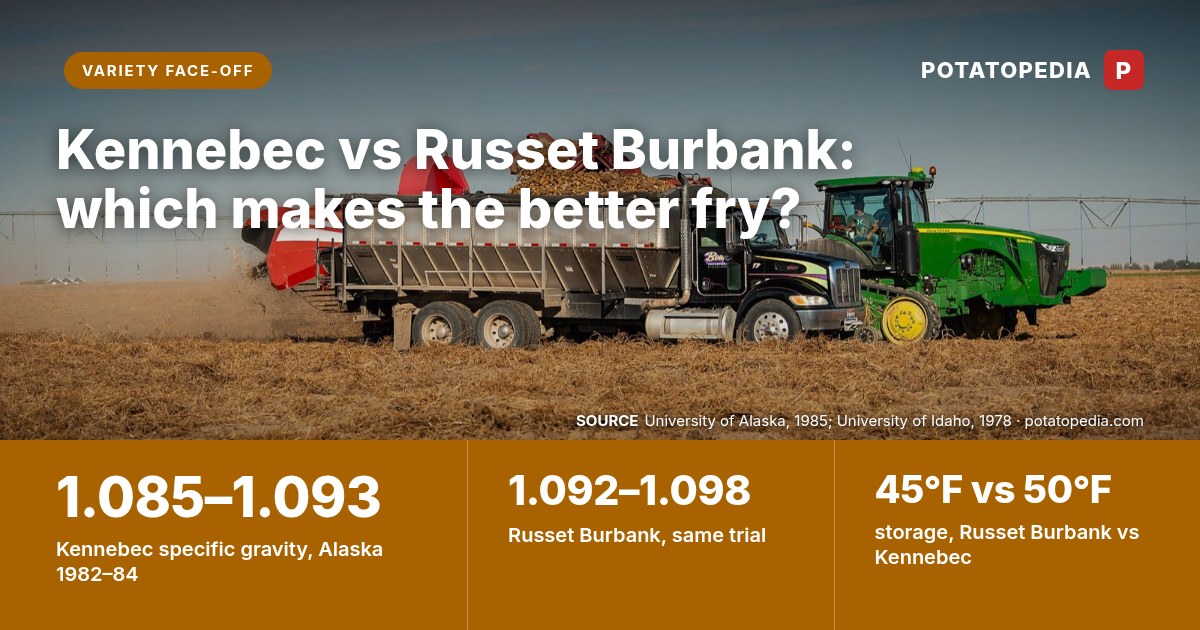
In a three-year trial at the Matanuska Research Farm in Alaska, the two varieties were grown side by side. Russet Burbank's specific gravity was 1.097 in 1982, 1.098 in 1983 and 1.092 in 1984. Kennebec's was 1.087, 1.093 and 1.085. Russet Burbank was higher every year, by margins larger than the trial's least significant difference of 0.003 in 1982.
The gap is not fixed. Idaho's 1978 guide gave Russet Burbank a range of 1.075 to 1.095 and described Kennebec's specific gravity as similar to Russet Burbank's in Idaho trials. Site, season and management move both varieties.
Which variety yields more?
Kennebec, in both sets of trials described here. Idaho's guide reported that Kennebec's main-crop yields were generally higher than Russet Burbank's, with a higher share of US No. 1 tubers. Russet Burbank yielded 200 to 400 cwt an acre in eastern Idaho and up to 500 cwt in western Idaho, with 40% to 80% US No. 1s. At 1 cwt an acre = 0.112 tonnes a hectare, that is about 22 to 45 tonnes a hectare, and up to 56.
The Alaska trial showed the same pattern. Kennebec's share of US No. 1 tubers was 78.8% in 1982, 96.7% in 1983 and 88.6% in 1984; Russet Burbank's was 48.9%, 90.5% and 66.6%. Under stress, Russet Burbank is prone to second growth, jelly end and hollow heart. Kennebec has its own defects: rough, oversized tubers, hollow heart and greening, because its tubers set close to the surface.
How do they store?
Here Russet Burbank has the clear advantage for a fry plant. It has long dormancy and stores well without excessive sugars at 45°F (about 7 °C) and above: about 5 months without a sprout inhibitor, or 10 to 12 months with one.
Kennebec has a shorter dormancy and has to be kept at about 50°F (10 °C) to hold its sugars low, which makes a sprout inhibitor necessary. Idaho's guide also rated it more prone to blackleg and storage rots than Russet Burbank. Fry processors want a light-coloured fry from potatoes held for months, which is where this difference counts.
Which resists disease better?
Kennebec, against several important diseases. It carries the R1 gene and is rated highly resistant to common races of late blight. It is resistant to mild mosaic viruses such as potato virus A and potato virus Y, and net necrosis is typically not seen even though it is moderately susceptible to leafroll virus. Its weak points are Verticillium wilt and pink eye, to which it is highly susceptible, plus common scab and Rhizoctonia.
Russet Burbank is rated highly resistant to blackleg and moderately resistant to common scab. It is susceptible to late blight, Fusarium wilt, leafroll, seed-piece decay, Verticillium wilt and potato viruses X and Y, and very susceptible to leafroll net necrosis.
Where is each variety grown?
Russet Burbank holds first place in planted area in North America, and its value to US growers was put at $1.4 billion a year in 2015. In 1978 it made up about 98% of Idaho's potato production. It is sold fresh and for baking as well as processed into frozen fries and dehydrated products.
Kennebec's area is recorded less fully. Seed is certified in Wisconsin, and Idaho's guide listed it mainly for chipping and home gardens. In Australia, a commercial clone imported from Vancouver was grown in Victoria, and a 1989 comparison of 10 clones picked the best one for the crisp industry.
So which makes the better fry?
For a frozen-fry line that runs most of the year, Russet Burbank: long tubers, usually higher dry matter, and cool storage without sugar build-up. Kennebec suits growers who want higher grade-out, better late-blight and virus resistance and a multipurpose crop for chips, fries, boiling and baking, and who can store it warm or use it sooner.
Is Kennebec good for French fries?
Yes. Extension descriptions rate Kennebec ideal for chipping and French frying, with medium to high specific gravity. In the Alaska trial its specific gravity ran from 1.085 to 1.093. Its limits are storage: it needs about 50°F (10 °C) to keep sugars low and a sprout inhibitor, so it is easier to use soon after harvest than to hold through a long frozen-fry season.
Why is Russet Burbank used for frozen fries?
Russet Burbank combines long, cylindrical tubers with high specific gravity, 1.092 to 1.098 in the Alaska trial and 1.075 to 1.095 in Idaho. It stores at 45°F (about 7 °C) without excessive sugars, for 10 to 12 months with a sprout inhibitor. That lets fry plants run on one variety for most of the year.
Is Kennebec a russet potato?
No. Kennebec has a smooth, thin, creamy buff skin and white flesh, and its tubers are oval to oblong. Russet Burbank has a brown, netted russet skin and long tubers. The two share white flesh and a late-season habit, but they come from different programmes: Kennebec from USDA breeding in 1948, Russet Burbank from a 1902 sport of Burbank's Seedling.
Sources
Akeley
Stevenson and Schultz, American Potato Journal (1948
Brown
HortScience (2015
University of Idaho Extension
Potato Varieties for Idaho (1978
All 7 sources and methodology
- Akeley, Stevenson and Schultz, American Potato Journal (1948)
- Brown, HortScience (2015)
- University of Idaho Extension, Potato Varieties for Idaho (1978)
- University of Idaho Extension, Specific Gravity of Potatoes, CIS 609 (1983)
- University of Alaska Agricultural and Forestry Experiment Station, Potato Variety Performance in the Matanuska Valley 1982-1984, Circular 49 (1985)
- University of Wisconsin–Madison Seed Potato Certification Program, Kennebec fact sheet (2022) and Russet Burbank fact sheet (2018)
- Strange and Blackmore, Australian Journal of Experimental Agriculture (1989).
Ask a follow-up
Answers grow from FAOSTAT, USDA, CIP and peer-reviewed research.