Blog · Country Profile
Peru in 5 numbers: potato production, yield, diet and trade
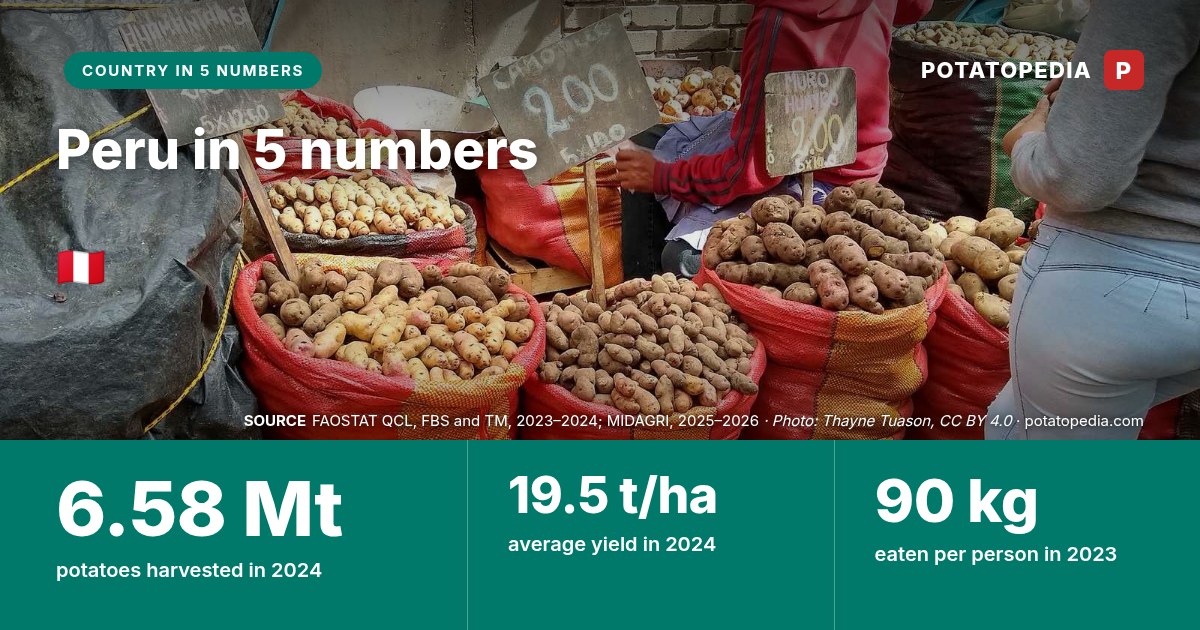
Peru grew 6.58 million tonnes of potatoes in 2024 at 19.5 tonnes a hectare, its people ate about 90 kg each in 2023, it imported 26,961 tonnes of frozen fries and 711,000 families grow the crop. Five numbers that describe the Peruvian potato sector.
Potatopedia Editorial··5 min read·892 words
In this story · 9
Peru harvested 6.58 million tonnes of potatoes in 2024, 28% more than in 2018, from 337,281 hectares at 19.5 tonnes per hectare. Its people ate about 90 kg each in 2023, more than two and a half times the world figure. Peru imports frozen fries, exports few fresh potatoes and has more than 3,000 varieties.
How many potatoes does Peru produce?
The first number is 6.58 million tonnes, the Peruvian harvest in 2024 and the largest in Latin America. Brazil, next in South America, grew 4.18 million tonnes that year and Colombia 2.49 million tonnes. Peru's crop was about 1.7% of the world total of 390.43 million tonnes, which placed it 16th among producing countries.
Output has risen in most recent years. The harvest was 4.70 million tonnes in 2014 and 5.13 million tonnes in 2018. It reached 6.05 million tonnes in 2022, fell to 5.46 million tonnes in 2023 and recovered to 6.58 million tonnes in 2024, a gain of 28% over six years.
Production is concentrated in the highlands, which grow about 90% of the crop. In the ministry's regional breakdown published in May 2025, Puno led with 1.2 million tonnes, followed by Huánuco with 792,000 tonnes, Ayacucho with 716,000 tonnes and La Libertad with 620,000 tonnes.
How productive are Peruvian potato fields?
The second number is 19.5 tonnes per hectare, the average Peruvian yield in 2024. In 2014 it was 14.8 tonnes, so yields rose by about a third in ten years. Over the same period the harvested area grew only about 6%, from 318,380 hectares to 337,281 hectares. Most of the extra output therefore came from higher yields, not more land.
Peru is still below the world average yield of 22.9 tonnes per hectare in 2024, and well below Argentina's 35.8 tonnes. The gap reflects where the crop is grown: small highland farms, some above 4,200 metres, where few other crops survive. Certified seed is one lever on yield. Peru's plant health service works with 1,214 registered seed potato producers and says certified seed can raise yields by up to 70%.
How many potatoes do Peruvians eat?
The third number is about 90 kg, the potato food supply per person in Peru in 2023 (89.99 kg). The world figure that year was 33.72 kg. The ministry's own estimate, published in May 2025, is 92 kg. The food balance figure covers fresh potatoes and products such as fries and crisps, measured as fresh-potato equivalent.
Peruvian consumption has been steady for a decade, between 86.6 kg and 92.7 kg per person a year since 2014. Neighbouring countries eat less: Bolivia 72.30 kg, Colombia 56.95 kg, Chile 48.83 kg and Argentina 35.95 kg in 2023.
Food is only part of the national supply. Of 5.59 million tonnes available in 2023, about 3.05 million tonnes went to food. Losses in storage and transport were 1.26 million tonnes, about 22%. Another 589,000 tonnes were fed to animals and 583,000 tonnes were kept as seed for the next crop.
What does Peru trade in potatoes?
The fourth number is 26,961 tonnes, the frozen potato products Peru imported in 2024, mostly fries. They cost US$42.0 million. In 2018 the country imported more by weight, 31,369 tonnes, but paid only US$26.0 million. Dividing value by weight, the price rose from about US$830 a tonne to about US$1,560 a tonne.
Exports are small next to the harvest. Peru shipped 9,760 tonnes of fresh potatoes worth US$1.72 million in 2024, up from 19 tonnes in 2018. Bolivia is the main buyer of fresh potatoes, with Brazil, the United States and European countries also listed as destinations. The country has phytosanitary access to 13 export markets. Chips made from native potatoes earned about US$940,000 in 2025, sold to 14 countries, up from 5 in 2020.
Who grows Peru's potatoes?
The fifth number is 711,000, the families that grow potatoes in Peru. Most farm in the high Andes, in 19 regions, and grow both modern and native varieties. The ministry counted more than 26 million workdays linked to the crop in 2024. In the main wholesale market of Lima, four varieties, Canchán, Yungay, Andina and Única, make up 80% of the potatoes sold.
The structural fact behind these numbers is diversity. Peru grows more than 3,000 potato varieties. The genebank of the International Potato Center in Lima, which began with about 1,800 accessions of traditional cultivars donated by Peru's national potato programme, now holds 5,107 active cultivated accessions. Of these, 4,670 are landraces from 18 countries, mainly in the Andes. It also stores more than 2,500 accessions of 140 wild potato species as botanic seed.
How many potato varieties does Peru have?
Peru grows more than 3,000 potato varieties, both modern and native. The International Potato Center in Lima conserves 4,670 landraces from 18 countries, mainly Andean, within 5,107 active cultivated accessions. A separate state collection in Cusco holds 711 native potato accessions gathered in Puno, Cusco and Apurímac.
Is Peru the largest potato producer in the world?
No. Peru is the largest producer in Latin America, with 6.58 million tonnes in 2024, but it ranked 16th in the world. Its harvest was about 1.7% of the global total of 390.43 million tonnes. Within South America, Brazil came second with 4.18 million tonnes and Colombia third with 2.49 million tonnes.
Does Peru export potatoes?
Only in small amounts. Peru exported 9,760 tonnes of fresh potatoes worth US$1.72 million in 2024, mostly to Bolivia, against a harvest of 6.58 million tonnes. It is a net importer of frozen fries, buying 26,961 tonnes worth US$42.0 million that year. Native-potato chips are a small, growing export, worth about US$940,000 in 2025.
Sources
FAOSTAT Crops and Livestock Products
QCL (2014–2024
FAOSTAT Food Balance Sheets
2014–2023
FAOSTAT Trade
crops and livestock products, TM (2018–2024
All 5 sources and methodology
- FAOSTAT Crops and Livestock Products, QCL (2014–2024)
- FAOSTAT Food Balance Sheets (2014–2023)
- FAOSTAT Trade, crops and livestock products, TM (2018–2024)
- MIDAGRI Ministry of Agrarian Development and Irrigation of Peru, press notes on potato production, regions, consumption and exports (May 2025), on potato exports and certified seed with SENASA (May 2026), on varieties and families (May and June 2026) and on native-potato chip exports (October 2026)
- International Potato Center (CIP) Genebank, cultivated and wild potato collections (read November 2026).
Ask a follow-up
Answers grow from FAOSTAT, USDA, CIP and peer-reviewed research.