Blog · Industry & Trade
Who makes optical potato sorters? 13 makers in 6 countries
Thirteen companies in six countries build optical sorters for potatoes, eight of them in the Netherlands. A neutral A–Z list by country: what each one makes for this step and one fact that can be checked on its own website.
Potatopedia Editorial··6 min read·1,111 words
In this story · 9
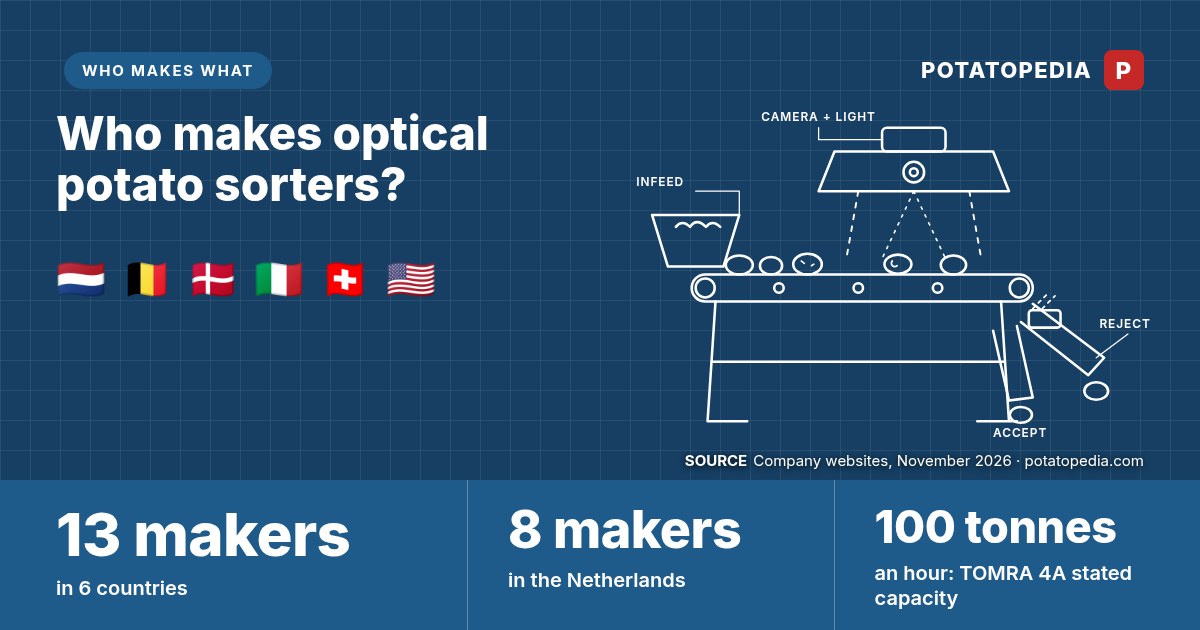
Thirteen companies in six countries build optical sorters or camera-based graders for potatoes. Eight are in the Netherlands; Belgium, Denmark, Italy, Switzerland and the United States have one each. Every name below was checked on the company's own website in November 2026, and the list is alphabetical within each country, with no ranking.
What does an optical potato sorter do?
An optical sorter photographs or scans each potato as it passes on rollers, a belt or a lane, then software decides where it goes. Mechanical fingers, flaps or air jets push rejects, stones and clods out of the main stream. Most machines also sort by size, shape and colour at the same time.
The machines on this list work at different points in the chain. Some sit on the farm at harvest or store intake, some grade seed potatoes, and some inspect cut strips inside a fry plant. Capacities below are the makers' own figures and depend on tuber size and set-up.
Which makers are based in the Netherlands?
Ellips, founded in 1989 in Eindhoven, makes the Elisam AI potato grader and a CleanFlow pre-sorter that removes stones and clods. It states that each potato is imaged up to 90 times as it rotates, with up to 20 internal scans using light transmittance. One lane handles 2 to 5 tonnes an hour; eight lanes reach up to 40 tonnes an hour.
Eqraft, based in Emmeloord with an office in Richland, Washington, makes the Eqrader optical sorting machine. It was developed with the Italian company BIOMETiC and combines a 360-degree external scan with internal scanners for disease, parasites, fungi and hollow spaces. Eqraft's March 2025 announcement said the first potato units were expected to run the following year.
Flikweert Vision, in Nieuwerkerk, builds the QualityGrader optical quality sorter and the Divider foreign-object sorter for potatoes and onions. The QualityGrader uses six or nine industrial RGB cameras with AI models and handles up to 30 tonnes an hour. The company tested its first prototype in 2020 and reported more than 300 machines in more than 20 countries in 2025.
Inovaa, in Emmeloord, builds the U-Vision camera sorter for unwashed potatoes and onions. Several cameras view each tuber, the drop height is kept low, and capacity is up to 1.5 tonnes per track an hour. Work on the machine began in 2019 as an optical sorter for seed potatoes, with Uniekum and Wevano as partners.
RMA Techniek, with its workshop in 's Heer Arendskerke, Zeeland, lists a Defects Sorter that uses AI to detect and sort potatoes by defect, an Optical Size Sorter and several 3D cameras for measuring tubers. For fry plants it makes the SolEye 3.0 camera for assessing the colour of French fries.
TechNature, in Moerkapelle, makes the PotatoCam optical sorter. It gives 16 views of each potato from top and side cameras, sorts into three output streams with an optional fourth, and is rated at 16 tonnes of seed potatoes an hour. An optional near-infrared module detects internal defects.
Tolsma-Grisnich, in Emmeloord, makes storage and grading equipment for potatoes and states almost 100 years of experience. Its optical range has three machines: the Optica S, the Optica Q quality sorter and the Optica CS size sorter. The Optica Q checks 15 to 18 tonnes of seed potatoes an hour.
Wevano, founded in 2000 and based in Emmeloord, builds sorting, grading, cleaning, inspection, storage and conveying machines and complete potato lines. It is named as a partner on Inovaa's U-Vision page, and its own site carries news of a spare-parts book for the U-Vision sorting machine.
Which makers are based elsewhere in Europe?
In Belgium, TOMRA Food has its main office at a research park in Leuven and states more than 45 years of work on potato sorting, grading and peeling. Its potato range includes the TOMRA 3A for field potatoes, the TOMRA 5A for fresh-pack potatoes and the TOMRA 5B for French fries and crisps. TOMRA states that the TOMRA 4A can sort up to 100 tonnes of potatoes an hour.
In Denmark, Newtec of Odense makes the Celox-P-DUAL-UHD for potatoes. Six cameras take 360-degree images of each potato up to 45 times, the machine sorts into up to 16 categories at once, and capacity is up to 30 tonnes an hour depending on potato size.
In Italy, Raytec Vision, founded in 2001 in Parma, makes the Ingenuity double-vision sorter, which combines visible colour and near-infrared sensing. It comes with a 1,500 mm or 2,500 mm vision area and 60 or 100 sorting channels. On unwashed potatoes it targets soil clods, stones and green tubers; on washed potatoes, rot and colour defects.
In Switzerland, the Bühler Group, based in Uzwil, lists frozen French fries among the applications of its vegetable optical sorters. It describes end-of-line sorting that removes foreign material such as wood, plastic, cardboard and glass, and a final sort for black and green colour defects.
Which maker is based in the United States?
Key Technology, at Walla Walla, Washington, with a second site at Beusichem in the Netherlands, is a member of the Duravant group. For potato strips it offers the ADR X automatic defect removal system and the VERYX 2.0 optical sorting platform. It states that it has delivered over 3,500 digital sorters to more than 3,100 customers in 81 countries.
What do these machines have in common?
Ellips, Eqraft, Flikweert Vision, Raytec Vision, RMA Techniek and TechNature all describe AI software trained on images of potatoes or produce. The main differences are in what is measured beyond the skin. Ellips uses light transmittance, TechNature and Raytec Vision offer near-infrared, Eqraft adds internal scanners and Key describes hyperspectral imaging for sugar ends in strips.
Stated capacities run from 1.5 tonnes per track an hour on the Inovaa U-Vision to 100 tonnes an hour on the TOMRA 4A. These numbers are measured in different ways, per lane, per track or per machine, so they show the range on offer rather than a like-for-like comparison.
Which country has the most optical potato sorter makers?
The Netherlands, with 8 of the 13 makers on this list. Four of them, Eqraft, Inovaa, Tolsma-Grisnich and Wevano, are in Emmeloord. The other five are in Belgium, Denmark, Italy, Switzerland and the United States. The count covers only companies whose own websites describe an optical or camera-based potato sorter.
How many tonnes an hour can an optical potato sorter handle?
It depends on the machine and the tuber size. Makers' own figures run from 1.5 tonnes per track an hour on the Inovaa U-Vision, through 16 tonnes on the TechNature PotatoCam and 30 tonnes on the Newtec Celox-P-DUAL-UHD and Flikweert QualityGrader, to 100 tonnes an hour on the TOMRA 4A.
Can an optical sorter see defects inside a potato?
Some can. Ellips states up to 20 internal scans per potato using light transmittance, for internal browning, hollow heart and dry matter. TechNature offers an optional near-infrared module for internal defects, and Eqraft's Eqrader adds internal scanners for disease and hollow spaces. Camera-only machines judge the skin, shape and size.
Sources
official company websites
read in November 2026: Bühler Group (2026
Ellips
2026
Eqraft
2026
All 14 sources and methodology
- official company websites, read in November 2026: Bühler Group (2026)
- Ellips (2026)
- Eqraft (2026
- news release of 5 March 2025)
- Flikweert Vision (2026)
- Inovaa (2026)
- Key Technology (2026)
- Newtec (2026)
- Raytec Vision (2026)
- RMA Techniek (2026)
- TechNature (2026)
- Tolsma-Grisnich (2026)
- TOMRA Food (2026)
- Wevano (2026).
Ask a follow-up
Answers grow from FAOSTAT, USDA, CIP and peer-reviewed research.