Lead story
 North America
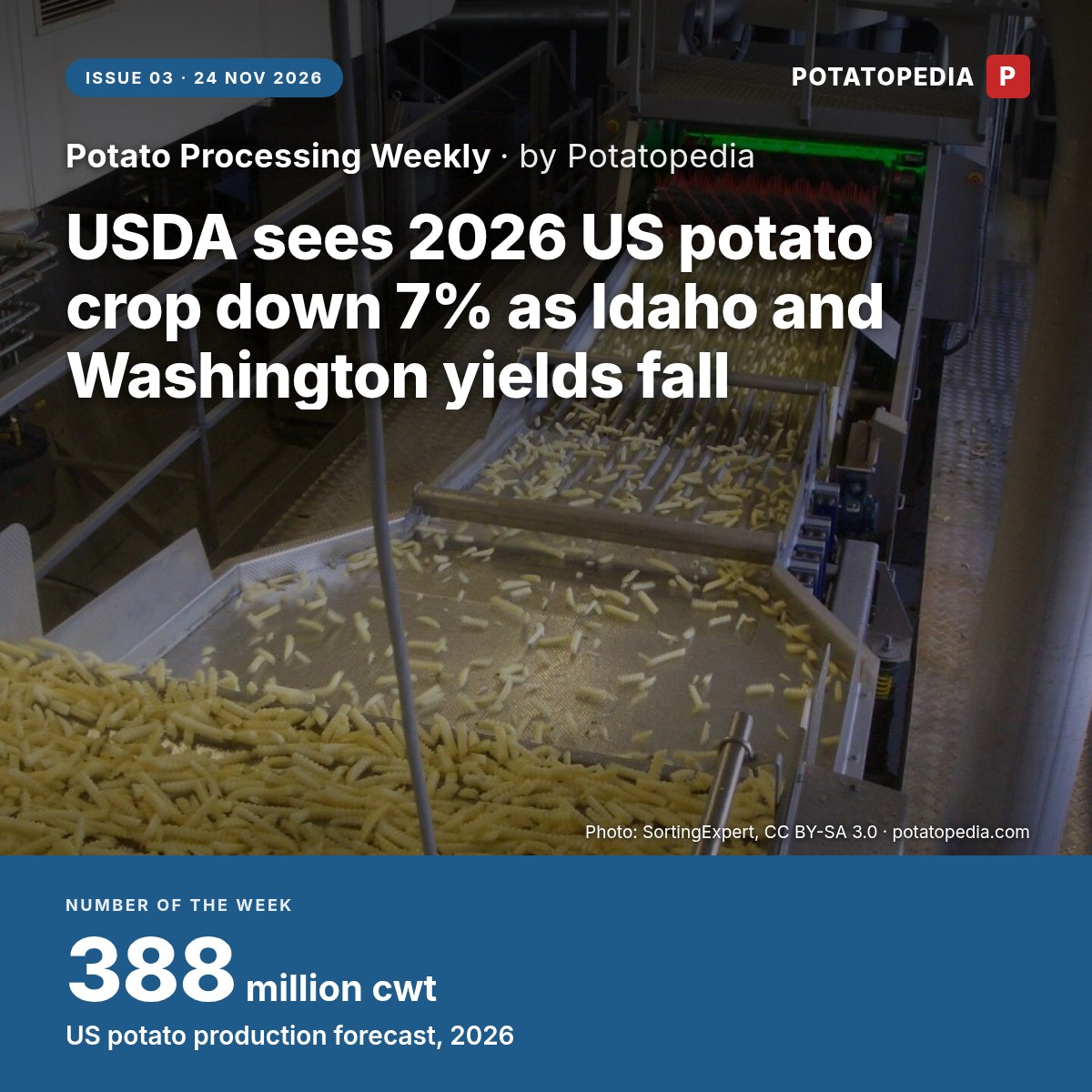
USDA sees 2026 US potato crop down 7% as Idaho and Washington yields fall
USDA's National Agricultural Statistics Service forecast the 2026 US potato crop at 388 million cwt on 10 Nov 2026, down 7 percent from 2025. Harvested area of 880,900 acres is the lowest on record, and the national yield fell to 440 cwt per acre, led by lower yields in Idaho and Washington.
Why it matters
Idaho and Washington supply most of the raw material for US frozen fry and dehydrated plants, and both states harvested less this year. A smaller crop on record-low acreage leaves fewer uncontracted potatoes on the open market, which can raise costs for processors that rely on spot purchases until the 2027 harvest.
Key numbers
388
million cwt
US potato production forecast, 2026
-7%
Change from 2025
880,900
acres
US harvested area, 2026
440
cwt per acre
US yield forecast, 2026
More in this issue
10 more storiesWhy it matters
As China turns from an importer of potato products into a supplier, its equipment makers want to sell them complete lines that compete with European suppliers. Buyers weighing a new line or a retrofit now have more Chinese turnkey options, including steam peeling and heat recovery equipment. Performance claims still have to be checked against references from plants already running these lines.
Why it matters
Hydrocutting blades wear out and must be replaced regularly, so supply lead times affect line uptime and yield at fry plants. More blade capacity at a major supplier should ease availability of spares and make it easier for processors to launch specialty or exclusive cuts.
Why it matters
In fry and specialty-cut plants the hydrocutter can bottleneck the line: a blocked cutting head stops production and costs yield. A system that switches automatically between cutting blocks goes straight at uptime and waste. The launch also shows FPS putting a specialist cutting supplier into the processing lines it sells.
Why it matters
A Belgian-owned fry line coming on stream in Uttar Pradesh adds frozen fry supply aimed at customers in India, wider Asia and the MENA region, markets that European and other exporters also serve. Its start-up will test whether locally contracted raw material can meet frying specifications at commercial scale.
Why it matters
The deal keeps a regional crisp brand, and an outlet for local processing potatoes, in Northern Ireland after the business had stopped operating. A buyer with existing frying operations may shorten the path back to production, but capacity, staffing and raw-material contracts have not yet been set out.
Why it matters
Peak-season throughput, not annual volume, is the bottleneck for many seed and raw-material packers, and this plant was sized around that peak. Pairing a wide mechanical sizer with camera grading to cut manual sorting reflects a wider shift as labor gets scarcer, and the supplier says larger operators are increasingly building whole new plants rather than upgrading old ones.
Why it matters
Placing the final on-edge hashbrown tight against the tray wall has been one of the remaining manual jobs on formed-potato packing lines. If vision-guided robots can do it reliably at line speed, processors can cut packing labor and run more consistent trays, a relevant option wherever frozen potato capacity is growing and staffing end-of-line work is hard.
Why it matters
Formed and shredded specialties are a smaller but higher-value segment than fries, and a 30% capacity step at one of Belgium's large processors adds supply for foodservice and retail buyers in Europe and beyond. The switch from water-based cooling to refrigeration is a practical example of how plants are cutting water use per tonne as water limits and costs rise.
Why it matters
Michael Foods and Bob Evans are major US buyers of potatoes for refrigerated sides, so their volumes signal demand for that raw material. The quarter's fall in segment profit came from egg prices, not potato, and private-label side dishes are adding volume in retail. Capital spending planned for fiscal 2027 points to egg, not new potato capacity.
Why it matters
A smaller, more variable British crop means tighter supply of large, processing-grade tubers and higher raw-material costs for fry and chip plants through the 2026/27 storage season. Low reservoirs and possible irrigation restrictions in East Anglia and the West Midlands, both key processing-potato areas, add risk to 2027 contract volumes and quality.
Data box
Post Holdings Foodservice sales fall 11.5% in Q4 as egg pricing eases
| Foodservice net sales, Q4 FY2026 | 635.2 USD million |
|---|---|
| Change in Foodservice net sales, Q4 | -11.5 percent |
| Foodservice segment profit, Q4 FY2026 | 91.2 USD million |
| Foodservice net sales, FY2026 | 2,584.6 USD million |
| Retail side dish volume change, Q4 | 4.7 percent |
| FY2027 capital spending outlook | 360-400 USD million |
19 Nov 2026 · Source
Spotlight
Company spotlight · chosen by the editors, not paid
Shandong Sensitar Industrial Equipment Co., Ltd.
Chinese equipment maker Shandong Sensitar presented its French fry, chip and flake processing lines at the China Potato Industry Summit Forum, which opened in Shanghai on 10 Nov 2026 alongside the FHC food show.
Coming up
All potato events →- Agromek 202624–27 Nov 2026 · Herning, Denmark
- India Potato Summit 202626–27 Nov 2026 · Lucknow, India
- INTERPOM 2026 (23rd)29 Nov 2026 – 1 Dec 2026 · Kortrijk, Belgium
- Global Potato Summit 202616–17 Dec 2026 · Gandhinagar, India
- Potato Expo 20275–7 Jan 2027 · Denver, USA
- AGRAVIA 2027 (formerly AGROS)20–22 Jan 2027 · Moscow, Russia