Blog · Nutrition
Are green potatoes poisonous? Solanine, explained
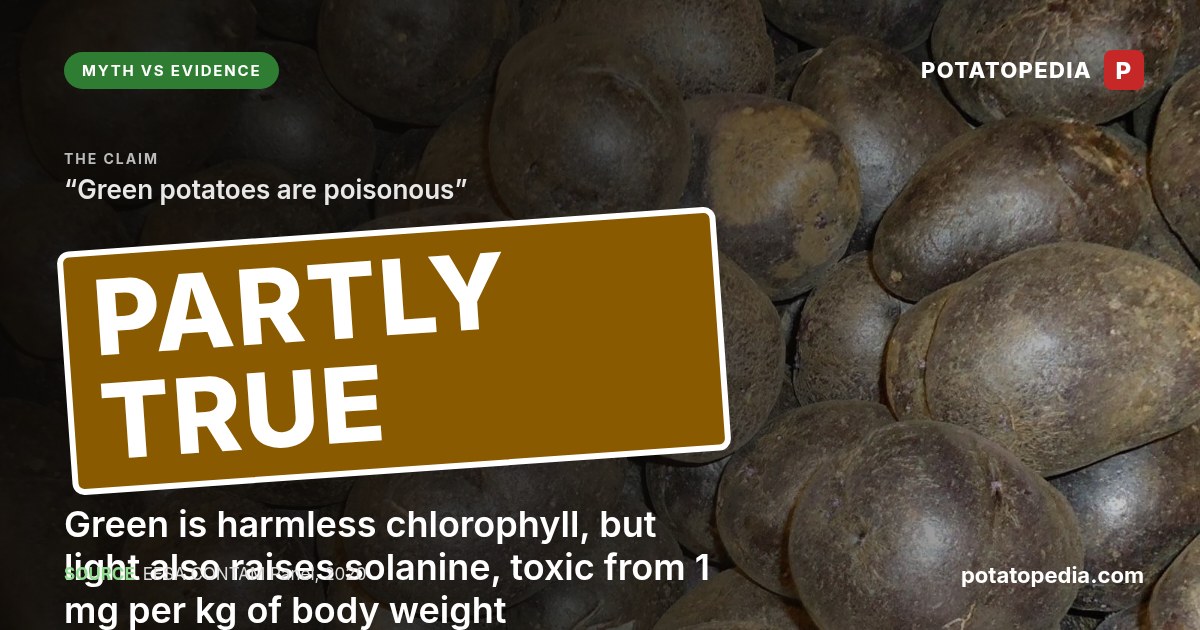
Partly true. The green in a potato is harmless chlorophyll, but the light that causes it also raises solanine and chaconine, which can cause illness from about 1 mg per kg of body weight. What volunteer studies, outbreaks and Europe's 2020 risk assessment show, and how much peeling removes.
Potatopedia Editorial··7 min read·1,297 words
In this story · 12
Partly true. The green colour in a potato is chlorophyll, which is harmless, but the light that causes it also drives the build-up of glycoalkaloids, mainly α-solanine and α-chaconine. These can cause nausea, vomiting and diarrhoea from about 1 mg per kg of body weight. Most of them sit in the skin, so peeling removes a large share.
Where does the claim that green potatoes are poisonous come from?
The warning to throw away green potatoes is old and widespread. The potato belongs to the nightshade family, and its leaves, sprouts and berries contain the same toxic compounds as the tuber, in larger amounts. A level of 200 mg of glycoalkaloids per kg of raw, unpeeled potato has been quoted as a safe upper limit in the scientific literature for about a century.
What makes a potato turn green?
Tubers form underground. Once they are exposed to light, after lifting, on shop shelves or in kitchens, the cells just below the skin start to make chlorophyll, the pigment of green leaves. Chlorophyll is not toxic. A 2020 study in Frontiers in Plant Science found that blue and red light induced chlorophyll and the two main potato glycoalkaloids in tubers, while neither built up in darkness or under far-red light.
The two processes run side by side but are separate. Researchers at Washington State University described chlorophyll and glycoalkaloid synthesis in 2006 as concurrent but independent responses to light. Glycoalkaloids can also rise in the dark, at about 20% of the rate in light, and temperature and cultivar play a part. Green colour is therefore a sign of light exposure, not a direct measure of toxin content.
What are solanine and chaconine, and how toxic are they?
Glycoalkaloids are natural defence compounds that help the plant resist insects and fungi. In potatoes, α-solanine and α-chaconine make up nearly all of them. They occur in tubers, peel, sprouts, berries, leaves and flowers, and the amount in a tuber depends on cultivar, maturity, growing conditions and storage.
In 2020 the contaminants panel of the European Food Safety Authority (EFSA) published a full risk assessment. It found that nausea, vomiting, diarrhoea and abdominal pain may occur from an intake of 1 mg of total glycoalkaloids per kg of body weight, and took this lowest-observed-adverse-effect level, drawn from case reports, outbreaks and volunteer studies, as its reference point. Severe cases have involved drowsiness, confusion, disturbed vision and low blood pressure, and doses of 3–6 mg per kg are considered potentially lethal. The panel found no evidence of harm in people from long-term intake of glycoalkaloids through potatoes.
What do studies in people show?
A 2005 single-dose study by the Dutch National Poisons Control Centre gave two or three volunteers each one of six treatments: glycoalkaloid solutions of 0.30, 0.50 or 0.70 mg per kg of body weight, or mashed potatoes giving 0.95, 1.10 or 1.25 mg per kg. The mashed potatoes contained nearly 200 mg/kg. No treatment caused systemic effects, but one volunteer on the highest dose became nauseous and vomited about four hours later. Clearance usually took more than 24 hours, so the compounds may accumulate with daily eating.
In 1979 the Quarterly Journal of Medicine described 78 schoolboys who fell ill after a school lunch on the second day of the autumn term; 17 were admitted to hospital. The potatoes were believed to come from a bag left in the stores since the summer term, and a second leftover bag had high α-solanine and α-chaconine in both flesh and peel. In 2015 a family in Baden-Württemberg, Germany, developed stomach ache and vomiting after eating jacket potatoes and potatoes boiled in their skins, which contained 236 mg of glycoalkaloids per kg.
How much glycoalkaloid do ordinary potatoes contain?
The EFSA assessment drew on 1,300 analytical results from 651 food samples, all potatoes or potato products. For main-crop and new potatoes combined, the mean was 51.2 mg/kg and 95% of results were below 116.8 mg/kg, with a range from 1.1 to 276.6 mg/kg.
The often-cited 200 mg/kg limit goes back to Bömer and Mattis in 1924, who linked batches of 257–583 mg/kg from Germany's 1922 harvest to illness, while batches below 200 mg/kg caused no reported problems. The EU has no legal maximum. Hungary sets 100 mg/kg for raw, unpeeled potatoes, and Finland and Sweden use 200 mg/kg.
For scale, a 60 kg adult reaches 1 mg per kg of body weight with 60 mg of glycoalkaloids. Dividing 60 mg by the concentration gives about 300 g of raw, unpeeled potato at 200 mg/kg, and about 1.2 kg at the 51.2 mg/kg average, before any peeling or cooking.
Does a green potato always contain too much?
Not in the main study that measured it. The 2006 Washington State work, published in the Journal of Agricultural and Food Chemistry, graded four cultivars for greening under retail lighting: Dark Red Norland, Russet Norkotah, Yukon Gold and White Rose. In Dark Red Norland and Russet Norkotah, glycoalkaloids rose closely with greening and chlorophyll. In Yukon Gold and White Rose they did not rise in proportion, especially at heavy greening.
Averaged over greening levels, the skin held 3.4 to 6.8 times more glycoalkaloids than the flesh, depending on cultivar. At every greening level studied, the flesh with its attached skin stayed within limits presumed safe. The authors concluded that rejecting greened tubers for toxicity was likely unfounded for those cultivars and greening levels. The EFSA assessment gives a wider range for potatoes in general, with 3–10 times more in the peel than in the flesh, and notes that a bitter or burning taste may accompany poisoning.
Do peeling and cooking remove solanine?
Partly. In the literature EFSA reviewed, peeling cut glycoalkaloid content by 25–75%. Boiling or blanching peeled potatoes removed a further 5–65%, and frying peeled potatoes in oil 20–90%. For unpeeled potatoes, microwaving cut levels by 3–45% and oven baking by 20–50%. Dishes eaten with the skin, such as jacket potatoes, keep the layer where concentrations are highest.
EFSA's exposure model assumed that 90% of potatoes are eaten peeled. It treated a margin of exposure of at least 10 below the 1 mg per kg reference point as no concern. Younger age groups fell short of that margin in the surveys with the highest average intake and among high consumers in all surveys; adults fell short only among the highest consumers. On potato-eating days, intakes were below the margin on up to 56% of days for toddlers and 50% for children, because a small body weight makes the same portion a larger dose.
So, are green potatoes poisonous? The verdict
Partly true. The green colour is harmless chlorophyll, but it marks light exposure, which also raises glycoalkaloids, and those cause illness from about 1 mg per kg of body weight. Ordinary potatoes tested in Europe averaged 51.2 mg/kg, and the flesh of greened tubers in a four-cultivar study stayed within presumed-safe limits. The risk grows with heavy greening, long storage, sprouting, a bitter taste and eating the skin, and is higher for small children.
The evidence base is thin. Volunteer studies have used two or three people per dose, and the reference point rests mainly on case reports and outbreaks.
Is it safe to eat a potato with a small green patch?
The studies did not test single patches, but greening sits just under the skin, where glycoalkaloids are 3–10 times more concentrated than in the flesh. Peeling removed 25–75% of glycoalkaloids in the studies EFSA reviewed in 2020. In a 2006 study of four cultivars, the flesh stayed within presumed-safe limits at every greening level tested.
Does cooking destroy solanine?
Only partly. In the studies EFSA reviewed in 2020, boiling peeled potatoes lowered glycoalkaloids by 5–65%, frying by 20–90%, oven baking unpeeled potatoes by 20–50% and microwaving by 3–45%. Peeling, at 25–75%, removed a similar or larger share. None of the reported ranges reached complete removal.
What are the symptoms of solanine poisoning?
Nausea, vomiting, diarrhoea and abdominal pain, which EFSA links to intakes from about 1 mg of total glycoalkaloids per kg of body weight. A bitter or burning taste may come with them. Severe cases have involved drowsiness, confusion, disturbed vision and low blood pressure, and doses of 3–6 mg per kg are considered potentially lethal.
Sources
EFSA Panel on Contaminants in the Food Chain
Risk assessment of glycoalkaloids in feed and food, in particular in potatoes…
Mensinga et al.
Regulatory Toxicology and Pharmacology (2005
McMillan and Thompson
Quarterly Journal of Medicine (1979
All 5 sources and methodology
- EFSA Panel on Contaminants in the Food Chain, Risk assessment of glycoalkaloids in feed and food, in particular in potatoes and potato-derived products, EFSA Journal (2020)
- Mensinga et al., Regulatory Toxicology and Pharmacology (2005)
- McMillan and Thompson, Quarterly Journal of Medicine (1979)
- Grunenfelder et al., Journal of Agricultural and Food Chemistry (2006)
- Okamoto et al., Frontiers in Plant Science (2020).
Ask a follow-up
Answers grow from FAOSTAT, USDA, CIP and peer-reviewed research.