Blog · Industry & Trade
Who makes potato harvesters? 7 makers in 5 countries
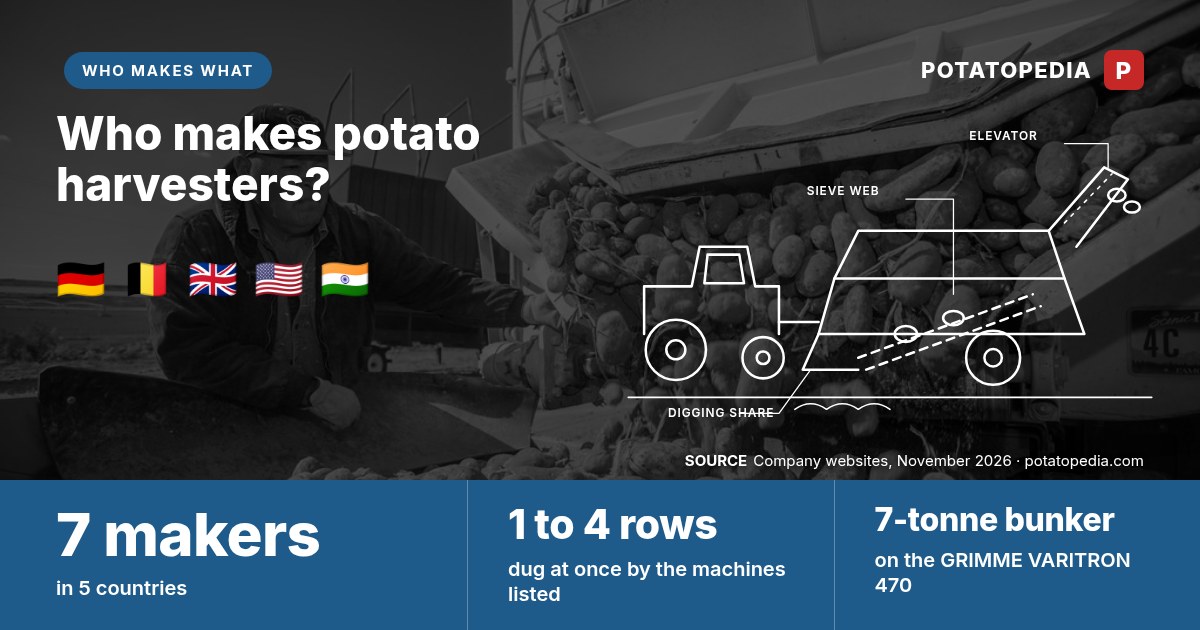
Seven companies in five countries build potato harvesters, from one-row trailed machines to four-row self-propelled ones with a 7-tonne bunker. A neutral list grouped by country: what each one makes for this step and facts that can be checked on its own website.
Potatopedia Editorial··6 min read·1,074 words
In this story · 11
Seven companies in five countries build potato harvesters and describe them on their own websites: GRIMME in Germany, AVR and Dewulf in Belgium, Standen Engineering in the United Kingdom, Lockwood and Spudnik in the United States, and Shaktiman-GRIMME in India. The list is grouped by country and alphabetical within each, with no ranking.
What does a potato harvester do?
A harvester lifts the potato ridge with shares, discs or rollers, then carries soil, stones, clods and haulm through moving webs and separators so that the tubers come out clean. The potatoes go either into a bunker on the machine or, by a side elevator or boom, straight into a trailer or truck driving alongside.
Harvesters differ in three main ways: the number of rows they dig at once, from one to four on this list; whether a tractor pulls them or they drive themselves; and whether they carry a bunker. Some makers also sell windrowers, which lift rows into a windrow that a harvester then picks up. All figures below are the makers' own and depend on soil and set-up.
Which maker is based in Germany?
GRIMME has its head office in Damme. The group states 3,300 employees, 38 locations and activity in over 120 countries, with sales of 792 million euros in 2025. Its group companies include Spudnik in the United States and ASA-LIFT, and it lists more than 150 machine types.
For potatoes it offers trailed and self-propelled harvesters. Its brochure describes the VARITRON 470 as a 4-row self-propelled harvester on a wheeled chassis with a 7-tonne NonstopBunker, whose circulating floor lets the driver unload without stopping. The front axle telescopes to set the track width between 3.0 and 3.6 m, and a camera system takes up to 13 cameras.
Which makers are based in Belgium?
AVR is based in Roeselare, with branches in Veendam in the Netherlands and Uetze in Germany. It traces its origins to 1849, when Pieter Vansteenkiste founded a forge for hand tools in Roeselare, and states 120 dealers in more than 50 countries. It names LOCKWOOD Manufacturing as a distribution partner for the United States.
AVR's harvester range runs from the Spirit 6100, a 1-row offset harvester with a six-tonne bunker, through the 2-row Spirit 6200 and Lynx and the Spirit 7200 and 9200i, to the Puma 4.0, which it describes as a four-row self-propelled range.
Dewulf is also headquartered in Roeselare and states more than 80 years of experience, with four locations in Belgium, the Netherlands, Romania and North America. It builds machines under the Dewulf and Miedema brands. Its self-propelled sieving harvesters are the 4-row Enduro, Kwatro, Kwatro Xtreme and Kwatro Xtreme Flow and the 2-row R3060; its trailed ones are the R2060, a 2-row sieving harvester with bunker, and the Torro, a light 2-row offset bunker harvester.
Which maker is based in the United Kingdom?
Standen Engineering is based in Ely, Cambridgeshire, states that it has made British machinery since 1846 and builds its machines in Ely. Its potato range covers bed formers, rotary tillers, planters, toppers and harvesters, and a separate division imports other specialist planting and harvesting machinery.
Its T2XS is a 2-row trailed harvester, a re-engineered version of the earlier T2. Standen states that the 2020 overhaul added 15% more separating area and, through a rear ROTO axle, 45% more machine levelling. Picking tables for 2, 4 or 6 people are offered. The range also includes the QM harvester.
Which makers are based in the United States?
Lockwood lists West Fargo, North Dakota, states that it has been in business for over 80 years, and its website is published by Crary Industries. Its range covers the 600 Series, the 673 Air Harvester, the 774 and sweet potato harvesters. The 774 works rows spaced 32 to 38 inches apart, needs at least 250 hp at the power take-off, digs at 2 to 5 mph and weighs 35,000 to 42,000 lb before options.
Spudnik has its headquarters in Blackfoot, Idaho. It dates its start to 1958, when the brothers Carl and Leo Hobbs began building equipment, and it joined the Grimme Group in 2003 while describing itself as an American company. Its 6740 is a 4-row harvester for rows spaced 34 to 36 inches, matched to tractors of 250 to 370 hp; working behind two 8-row windrowers it can take in up to 20 rows. Its AirSep line has the 2-row 6621 and the 3-row 6631.
Which maker is based in India?
Shaktiman-GRIMME is a 50:50 joint venture between the Indian implement maker Shaktiman and GRIMME, set up to develop and market potato and other root-crop machines in India. It is based at Bhunava village in Gondal taluka, Rajkot district, Gujarat, and also makes potato planters.
Its SGPH 200 is a 2-row automatic elevator potato harvester with a working width of 1,400 mm. The technical table on its page calls for a four-wheel-drive tractor of 75 hp (55 kW) and above.
How do these harvesters compare?
Row counts run from one on the AVR Spirit 6100 to four on the GRIMME VARITRON 470, the Dewulf Enduro and Kwatro, the AVR Puma 4.0 and the Spudnik 6740. The European four-row machines are self-propelled and carry their crop in a bunker, while the North American machines are pulled by tractors of 250 hp or more and load trucks by boom as they go.
Several makers are linked. Spudnik belongs to the Grimme Group, Shaktiman-GRIMME is half-owned by GRIMME, and AVR sells through Lockwood in the United States. The list covers only makers whose own websites could be read and checked in November 2026, so it is a starting point, not a complete census.
Which countries make potato harvesters?
On this list, harvesters are made in Germany, Belgium, the United Kingdom, the United States and India. Belgium and the United States have two makers each: AVR and Dewulf, both in Roeselare, and Lockwood and Spudnik. GRIMME is in Germany, Standen Engineering in the United Kingdom and the Shaktiman-GRIMME joint venture in Gujarat, India.
What is the difference between a trailed and a self-propelled potato harvester?
A trailed harvester is pulled and powered by a tractor through its power take-off, as with the Standen T2XS or the Lockwood 774, which needs at least 250 hp. A self-propelled harvester has its own engine and cab, such as the GRIMME VARITRON 470 or the Dewulf Kwatro, and can carry a large bunker, such as the 7-tonne NonstopBunker on the VARITRON 470, which unloads on the move.
How many rows can a potato harvester dig at once?
The machines on this list dig 1 to 4 rows. The AVR Spirit 6100 takes one row, the Standen T2XS and Shaktiman-GRIMME SGPH 200 take two, the Spudnik 6631 takes three, and four-row models include the GRIMME VARITRON 470 and Spudnik 6740. Behind windrowers, the 6740 can gather up to 20 rows in one pass.
Sources
official company websites
read in November 2026: AVR (2026
Dewulf
2026
GRIMME Group
2026) and GRIMME VARITRON 470 brochure (2025
All 7 sources and methodology
- official company websites, read in November 2026: AVR (2026)
- Dewulf (2026)
- GRIMME Group (2026) and GRIMME VARITRON 470 brochure (2025)
- Lockwood Manufacturing (2026)
- Shaktiman-GRIMME (2026)
- Spudnik Equipment (2026)
- Standen Engineering (2026).
Ask a follow-up
Answers grow from FAOSTAT, USDA, CIP and peer-reviewed research.