Lead story
 North America
Colorado study names Verticillium dahliae as main cause of potato early dying
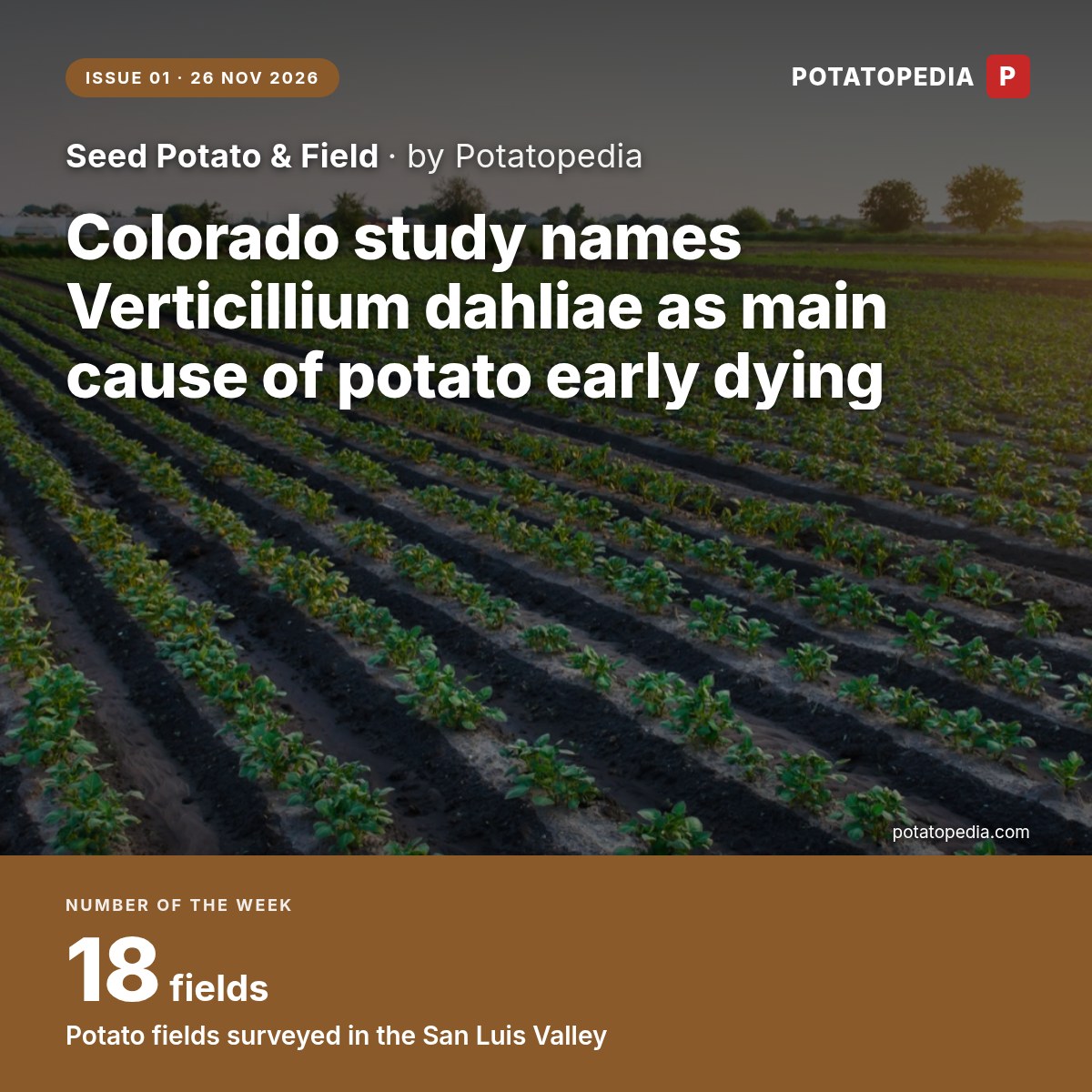
Colorado State University researchers report in Plant Disease, published 13 Nov 2026, that Verticillium dahliae is the primary cause of potato early dying in the San Luis Valley. Surveys of 18 fields over three seasons found the fungus in every affected sample, and greenhouse tests showed it alone reproduced the disease.
Why it matters
Potato early dying is often treated as a pathogen complex, which makes control choices harder. If one fungus is driving the disease in the San Luis Valley, growers and agronomists there can focus soil testing, rotation and fumigation decisions on Verticillium inoculum levels rather than on black dot.
Key numbers
18
fields
Potato fields surveyed in the San Luis Valley
3
seasons
Growing seasons covered by the survey
100%
PED-affected samples with Verticillium dahliae
More in this issue
10 more stories
Why it matters
Low nitrogen needs and strong tuber blight resistance can lower input costs and storage risk for ware growers. Against that, the variety's sensitivity to internal bruising and to metribuzin, and its late bulking, affect how it is harvested, handled and sprayed. The profile itself notes that its figures come from global data and may not hold under South African conditions.
Why it matters
Seed-borne disease and virus-driven seed degeneration cap yields in one of Asia's larger potato producers, and the review argues that tools already tested locally need multi-location validation before wider use. For seed suppliers and agronomists working in Bangladesh, it sets out where diagnostics, seed health rules and quarantine surveillance are weakest.
Why it matters
Purple top surveillance in Colombia still relies on yellow sticky traps that must be checked and identified by hand, which is slow on small hillside farms. Automated counting with mapped alerts could give growers earlier warning of vector pressure, but no pilot site, timeline, supplier or cost has been set, so nothing changes in the field yet.
Why it matters
Seed growers in Great Britain, mostly in Scotland, regain access to their former largest export market, while EU buyers regain access to varieties multiplied in GB. The catch is timing: nothing changes before 1 Mar 2028, so the 2027 crop is still sold under today's rules, and GB growers will have to work to EU plant passport and plant health rules.
Why it matters
Three of the five honorees built their careers on getting clean, certified seed and better varieties to growers, and two worked in sub-Saharan Africa, where formal seed systems are still small. The awards point to where the sector sees the bottleneck: seed multiplication and variety uptake, not just new breeding.
Why it matters
The work is aimed at lunar bases, but its core finding matters on Earth: high organic-matter amendments counteracted heavy-metal stress and poor root growth in a hostile, nutrient-poor substrate. It also adds evidence on how potatoes keep their nutritional quality and glycoalkaloid levels under soil stress, and a follow-up on 10 varieties could show which genetics cope best with marginal soils.
Why it matters
Growers facing potato cyst and other parasitic nematodes have few control options, and chemical nematicides are under environmental pressure. Litchi tomato is already studied as a trap crop; this work suggests its biomass could also be a source of active compounds, but extraction choices strongly change the result. The findings are laboratory enzyme tests, not field trials.
Why it matters
Water access is turning into a dividing line between Irish growers who can meet pre-pack and salad specifications and those who cannot. Uneven quality and lower dry matter in late-lifted crops raise storage risk going into the winter months. Growers planning 2027 plantings will weigh irrigation capacity and its cost per application more heavily.
Why it matters
The work is far from any commercial field, but it adds controlled data on how potato plants respond to toxic, heavy-metal-rich substrates and how organic amendments can buffer that stress. The planned 10-variety comparison is a varietal screen that breeders may want to watch for tolerance traits.
Why it matters
Uzbekistan relies heavily on imported seed, so any shift toward locally multiplied, disease-free early-generation material could change demand for imported basic seed over time. For now this is a discussion stage only, with no sites, budget or output targets, so suppliers should treat it as a signal rather than a commitment.
Data box
Seed and research leaders win 2026 World Potato Congress awards in Kenya
| Industry Award recipients | 5 people |
|---|---|
| Shangi share of Kenyan market (WPC figure) | 80 % |
| Certified seed supplied by Singus Ltd. | 30 tonnes a year |
| Farmers trained by Anneh Mbugua | 2,500+ farmers |
| Minitubers from Frito-Lay tissue culture facilities | 30 million a year |
17 Nov 2026 · Source
Spotlight
Company spotlight · chosen by the editors, not paid
Techno Seeds
Uzbekistan's agriculture ministry and Jordanian seed potato producer Technoseeds agreed in Nov 2026 to pick candidate regions for a pilot project testing tissue-culture and aeroponic minituber production under Uzbek conditions.
Coming up
All potato events →- India Potato Summit 202626–27 Nov 2026 · Lucknow, India
- INTERPOM 2026 (23rd)29 Nov 2026 – 1 Dec 2026 · Kortrijk, Belgium
- Global Potato Summit 202616–17 Dec 2026 · Gandhinagar, India
- Potato Expo 20275–7 Jan 2027 · Denver, USA
- AGRAVIA 2027 (formerly AGROS)20–22 Jan 2027 · Moscow, Russia