Blog · Varieties
Shangi vs Tigoni: Kenya's two workhorse potatoes compared
Shangi matures in three months or less and sprouts within a month; Tigoni takes 3–4 months and stays dormant for 2–3. A side-by-side look at the breeding, dormancy, dry matter, uses, late blight ratings and growing areas of Kenya's two best-known CIP-derived potatoes.
Potatopedia Editorial··6 min read·1,157 words
In this story · 12
Shangi and Tigoni are both CIP-derived potatoes grown in Kenya's highlands, but they suit different jobs. Shangi matures in three months or less and sprouts within a month of harvest, which keeps fresh tubers and seed on the market all year. Tigoni takes 3–4 months, stays dormant for 2–3 months and is rated more tolerant of late blight.
Where do Shangi and Tigoni come from?
Tigoni is the Kenyan name of clone CIP381381.13, bred by the International Potato Center from a cross between CIP378493.915 and a Precoz bulk. Kenya released it formally in 1998. The same clone was released as Cipira in Cameroon in 1992, as IDIAP 92 in Panama, Avotre in Madagascar in 1999, Thandizo in Malawi and Lulimile in Mozambique in 2011, and Tengeru in Tanzania and Rwanda in 2012.
Its sibling clone CIP381381.20, from the same two parents, was released in Kenya in 1998 as Asante. Asante and Tigoni are therefore sister varieties from one CIP cross.
Shangi has no published pedigree. It is a farmer selection that spread out of on-farm trials, and a preliminary molecular analysis places it within CIP genebank germplasm. It expanded quickly across Kenya's potato areas from 2005 and was officially released only in 2015, about ten years after farmers had adopted it.
How much of Kenya's crop do they cover?
Kenya harvested 2.19 million tonnes of potatoes from 225,948 hectares in 2024, an average of 9.7 tonnes per hectare. Shangi dominates that area. A 2024 peer-reviewed case study put it at around 80% of the production area, and a 2024 CIP breeding overview gave it a 70% market share. Neither source gives a share for Tigoni.
Both varieties are in the formal seed system. The 2021 catalogue of the National Potato Council of Kenya (NPCK) names ADC-Molo, KALRO-Tigoni and Kisima Farm as the main producers of certified Shangi seed, and ADC-Molo and KALRO-Tigoni for Tigoni. In the 2019 catalogue, Shangi appeared on the variety lists of 18 of the 27 seed potato producers named, and Tigoni on 3.
How fast do they mature, and how long do they stay dormant?
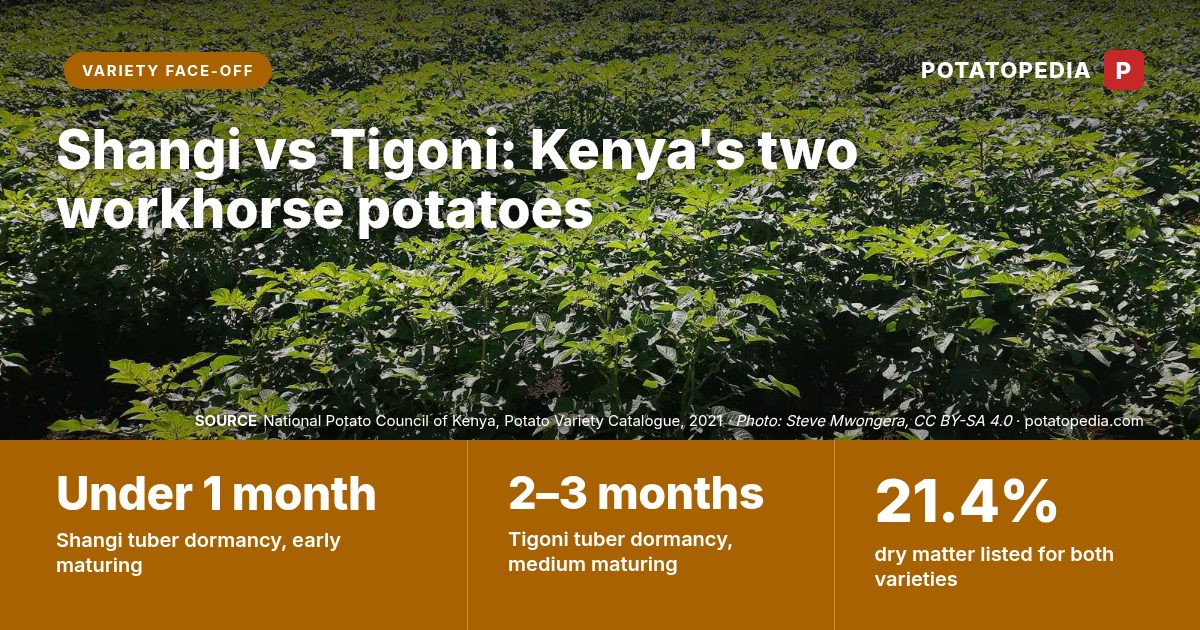
Maturity is the first difference. The NPCK 2021 catalogue classes Shangi as early, at three months or less, and Tigoni as medium, at 3–4 months.
Dormancy is the larger difference. The catalogue lists Shangi's tuber dormancy as short, under 1 month, against long, 2–3 months, for Tigoni. CIP's own catalogue records a highland dormancy of 68 days for clone CIP381381.13. Short dormancy means Shangi tubers sprout soon after harvest: they cannot be held long as ware, but they can be replanted almost at once.
The 2024 case study argued that this trait, long treated by breeders as a weakness, explains much of Shangi's spread. With little storage on Kenyan farms, a variety that is always being harvested and is always ready to plant gives traders a steady supply and gives farmers seed when they need it. In CIP's 2024 breeding plan for Kenya, Shangi is the variety a new clone must replace, with storability as the trait to improve on.
Which has more dry matter, and what is each used for?
The NPCK catalogues of 2019 and 2021 give the same dry matter, 21.4%, for both varieties, so the published Kenyan data do not separate them on this point. CIP's catalogue lists 23% dry matter for clone CIP381381.13 and describes its tubers as high in dry matter, measured in CIP's own trials.
NPCK lists Shangi for chips and table use, and Tigoni for table use and as good for frozen chips. Tigoni has long-oval tubers with smooth white skin, shallow eyes and pale yellow flesh. Shangi has oval tubers with smooth cream skin, medium to deep eyes and white flesh. The 2024 case study cites a 2017 storage study in which processors wanted thin peels to reduce waste and preferred Shangi less because of its thicker peel.
How do they compare on late blight and viruses?
The NPCK 2021 catalogue describes Shangi as moderately susceptible to late blight. It describes Tigoni as highly tolerant of late blight and extremely resistant to potato virus X (PVX). The 2019 edition had called Tigoni moderately tolerant of late blight, so the rating was raised in the later catalogue.
CIP rates clone CIP381381.13 as resistant to late blight and extremely resistant to PVX, but susceptible to potato virus Y and highly susceptible to potato leafroll virus. On the published ratings, Tigoni is ahead of Shangi on late blight, while Kenya's catalogue gives Shangi no virus rating.
Which yields more?
NPCK gives Shangi a medium yield potential of 30–40 tonnes per hectare and Tigoni a medium to high potential of 35–45 tonnes per hectare. CIP recorded 39.63 tonnes per hectare for clone CIP381381.13 in its trials.
Both potentials sit far above Kenya's national average of 9.7 tonnes per hectare in 2024. Catalogue figures describe what a variety can do with clean seed and good management, not what a typical farm harvests, so the gap between the two varieties is small next to the gap between potential and farm yields.
Where are they grown?
NPCK recommends Shangi at 1,500 metres above sea level or higher and lists Nyandarua, Kiambu, Nyeri, Laikipia, Meru, Nakuru, Bomet, Narok, Kwale, Nandi, Kisii, Kericho, Elgeyo Marakwet, Uasin Gishu, Trans-Nzoia, West Pokot and Taita-Taveta counties and the Cherangani Hills as areas where it does well. Tigoni is recommended for all regions suitable for potato production.
Outside Kenya, Tigoni's clone has been released under other names in Cameroon, Madagascar, Malawi, Mozambique, Rwanda, Tanzania and Panama. Shangi has spread less formally: the 2024 case study reports that it is becoming popular in eastern Uganda.
Shangi or Tigoni: which is better for what?
Shangi suits growers who plant back to back and sell fresh, and buyers who need tubers every month. It is early, it sprouts quickly, and 18 of the 27 seed producers in the 2019 catalogue offered it. Its weak points are short storage life, a thicker peel and a moderately susceptible late blight rating.
Tigoni suits growers who need to hold seed or ware for 2–3 months, farm where late blight pressure is high, or supply frozen chips. It has longer dormancy, a higher late blight rating, shallow eyes and a slightly higher yield potential. On dry matter, Kenya's catalogue data put the two level at 21.4%.
Is Shangi good for chips?
Kenya's national potato catalogue lists Shangi for chips and table use, with 21.4% dry matter, the same as Tigoni. Processors in a 2017 storage study preferred thinner-peeled varieties to cut waste and rated Shangi lower for its thicker peel. Its short dormancy, under 1 month, also limits how long it can be stored before processing.
Why does Shangi sprout so soon after harvest?
Shangi has a short tuber dormancy, listed as under 1 month in Kenya's 2021 variety catalogue, against 2–3 months for Tigoni. Its tubers therefore sprout soon after lifting. For farmers this means seed can go back into the ground the next season without cold storage, but ware potatoes cannot be kept for long before they sprout.
Who bred the Tigoni potato?
Tigoni is clone CIP381381.13, bred by the International Potato Center from a cross of CIP378493.915 and a Precoz bulk. Kenya released it in 1998. It shares its name with KALRO's potato research centre at Tigoni in Kiambu County, which is still one of the main producers of its certified seed in Kenya's 2021 catalogue.
Sources
National Potato Council of Kenya
Potato Variety Catalogue (2019, 2021
International Potato Center
CIP), Potato Catalogue and genebank accession record for CIP381381.13 (2026
International Potato Center
Mendes, Potato breeding: overview of the operations in Africa (2024
All 5 sources and methodology
- National Potato Council of Kenya, Potato Variety Catalogue (2019, 2021)
- International Potato Center (CIP), Potato Catalogue and genebank accession record for CIP381381.13 (2026)
- International Potato Center, Mendes, Potato breeding: overview of the operations in Africa (2024)
- Friedmann, Polar and Mendes, Frontiers in Sociology (2024)
- FAOSTAT, Crops and livestock products (2024).
Ask a follow-up
Answers grow from FAOSTAT, USDA, CIP and peer-reviewed research.